
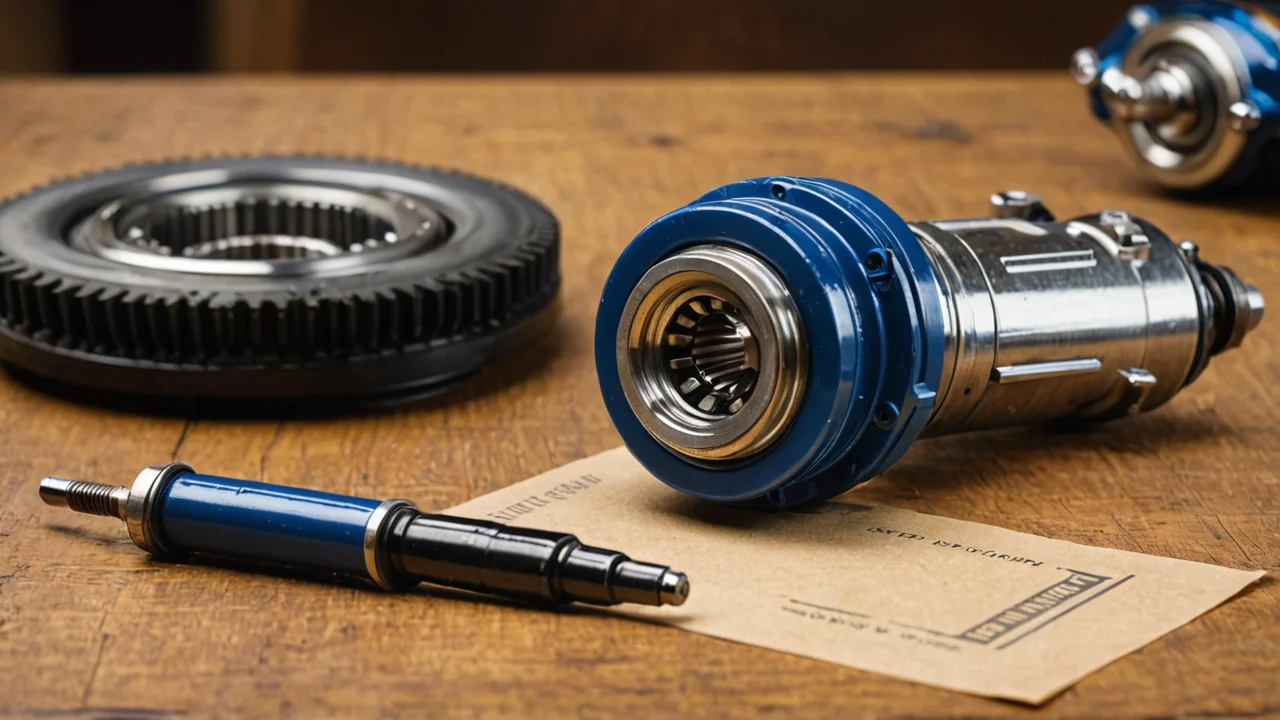

A transmission is the set of parts that lets an engine or motor run at the speed it works best while the wheels turn at whatever speed the road demands — and the choice of which kind of transmission a car has shapes how it drives, how it fails, and what it costs to keep alive. Everything below sorts by that choice: how each design actually moves power, what maintenance each one needs, how you diagnose the noises and slips that send people looking for answers, and when a repair beats a replacement.
How power gets from the engine to the wheels, and why the ratio has to change
An engine produces useful torque only across a narrow band of rpm, and it cannot turn backward, so something has to sit between the crankshaft and the wheels that multiplies torque, changes direction for reverse, and disconnects the engine when the car is stopped. That is the transmission's whole job. The manual does it with gears on shafts and a clutch the driver operates; the automatic does it with planetary gearsets, clutches and bands engaged by hydraulic pressure; the continuously variable transmission does it with a steel belt or chain running between two variable-diameter pulleys; the dual-clutch transmission does it with two computer-shifted clutches and two input shafts, one holding the next gear ready; and an electric car mostly skips the problem with a single fixed reduction gear, because an electric motor makes strong torque from zero rpm.
That last point explains a lot of modern confusion. A single-speed EV has no shift quality to complain about, no fluid to change, and no clutches to burn — the trade-off is that the motor must spin fast at highway speed, which costs efficiency and adds gear whine, and the car loses the torque multiplication that gearing gives a combustion engine at low speed. If you are shopping across powertrain types, the transmission is one of the biggest reasons the ownership experience differs, not a footnote.
The failure modes follow the design directly. A manual's clutch wears as a consumable and announces itself with a slipping engine at high load or a high, late engagement point. A conventional automatic's most common early death is heat and dirty fluid — the fluid does double duty as hydraulic medium and lubricant, and when it degrades, shift quality degrades with it. A CVT's belt-and-pulley interface is the wear point, and the symptom is a shudder or a hesitation under acceleration rather than a clean slip. A dual-clutch's weak link is usually the clutch packs and the mechatronic unit that commands them, and the tell is a jerky low-speed crawl that feels like a bad driver rather than a bad gearbox.
Fluid and service intervals: the single most consequential decision owners get wrong
Change the fluid on the schedule the manufacturer publishes, and treat "lifetime fluid" as a marketing phrase rather than a maintenance plan. Fluid is the cheapest thing you will ever put into a transmission and the only thing standing between the internals and heat death. It carries hydraulic pressure, lubricates bearings and gears, and carries heat away from the clutches — when it oxidizes, it stops doing all three well, and the damage it allows is not reversible by a later fluid change.
The practical sequence matters more than the brand. Check the level and condition first, following the manufacturer's specified procedure — many automatics require the engine running, the transmission at a specified temperature, and the car level, and checking it cold gives a false reading. Then decide between a drain-and-fill and a full fluid exchange. A drain-and-fill replaces only the fluid in the pan, which on many units is a fraction of total capacity, but it is gentle and repeatable. A full exchange replaces nearly everything at once, which is what you want on a healthy high-mileage unit and exactly what you should think twice about on a neglected one, because dislodged debris can migrate into valve body passages. On a transmission that has never been serviced and is already shifting poorly, a fluid change can turn a marginal problem into a dead unit — that is a real trade-off, not a myth, and it is why a shop will sometimes refuse the job.
For a CVT, use only the specified fluid type; the belt-to-pulley friction coefficient depends on it, and the wrong fluid produces shudder that no relearn will fix. For a dual-clutch, the fluid and filter service is separate from the gear oil in many designs, and skipping it is a common cause of judder. Manual gearboxes are the forgiving case — gear oil ages slowly, and most owners never touch it, though a change at high mileage is cheap insurance. The limits are real: fluid maintenance preserves a healthy transmission and does almost nothing for one that already has mechanical damage. If the pan shows clutch material or metal, fresh fluid is not the answer.
Diagnosing the symptoms: slip, shudder, delayed engagement, and noise
Read the codes before you read the internet. A modern transmission is controlled by a computer that stores fault codes for solenoid circuits, speed sensor signals, and clutch adaptation limits, and those codes narrow the diagnosis faster than any symptom description. A code for a shift solenoid or a speed sensor points at electronics; a code for excessive clutch fill time or adaptation at its limit points at internal wear. The distinction decides whether you are looking at a few hundred dollars of parts or a rebuild.
Then match the symptom to the mechanism. A transmission that slips under load — engine rpm rises without corresponding acceleration — is losing clamping force, whether from low fluid, a worn clutch pack, or a failing pump. A shudder at a specific speed, often during a light-throttle upshift or a torque converter clutch apply, usually means the lockup clutch is chattering or the fluid is contaminated; a shudder that appears only when accelerating from a stop in a CVT points at the belt and pulleys. Delayed engagement when you move the lever from park to drive is often low fluid or a sticking valve body, and it gets worse as the unit warms. Whining that rises with road speed is usually a bearing or gear wear issue; whining that tracks engine rpm is often the pump. A clunk on tip-in can be a worn mount rather than the transmission at all, which is why a proper diagnosis includes the mounts and the driveshafts.
Do the cheap checks first: fluid level and condition by the specified procedure, battery voltage, and a scan for codes. Low voltage from a weak battery is a genuinely common cause of bizarre shift behavior on computer-controlled units, because solenoids need clean current. What you should not do is add a friction modifier or a "shift improver" additive to chase a symptom — those products change the friction characteristics the computer was calibrated around, and on a CVT or dual-clutch they can make things worse. The honest limit of DIY diagnosis is the pan: if you find clutch material or metallic paste, stop driving it and get it to a shop, because every additional mile converts a rebuild into a replacement.
Repair, rebuild, or replace: how to decide and what drives the price
Get a firm diagnosis with the unit out of the car before you authorize anything, because the price difference between a solenoid pack, a valve body, a clutch pack, and a complete rebuild is enormous and the symptom can look identical from the driver's seat. Ask the shop to state what failed and why; a diagnosis that begins and ends with "it needs a transmission" is not a diagnosis. A remanufactured unit from a reputable rebuilder is often the middle path — it comes with updated parts and a warranty, and it is usually faster than a bench rebuild because the shop is not waiting on parts and machine work.
A used unit from a salvage yard is the cheapest option and the riskiest, because you are buying the previous owner's maintenance history. A rebuild by a local shop can be excellent or terrible depending on the shop, and the warranty is the tell. The costs that surprise people are the peripheral ones: a new torque converter, a cooler flush to remove debris from the old unit, new mounts, and the labor to program or relearn the new unit's adaptations. Budget for those separately, because a quote that omits them is not the real number.
The decision rule that holds up: if the car's value is close to or below the cost of a remanufactured unit plus installation, and the rest of the car is tired, replacement of the vehicle is rational. If the car is otherwise sound and the transmission is the only major fault, a remanufactured unit with a real warranty is usually the right call, because you keep a known car and avoid the transaction costs of buying another. The wrong choice is a cheap rebuild with a short warranty on a car you plan to keep for years — you will pay twice.
Manual, automatic, CVT, dual-clutch: what each one costs you over the life of the car
Pick the transmission for the driving you actually do, not the driving you imagine. A manual is the cheapest to buy, the cheapest to service, and the most forgiving of neglect, and a clutch replacement is a known, bounded expense — but it is a shrinking option in the US market, which limits your choice of vehicle and hurts resale in some segments. A conventional automatic with a torque converter is the most durable general-purpose choice and the smoothest in traffic, at the cost of fluid service discipline and a rebuild that is expensive when it finally comes. A CVT delivers the best fuel economy in its class and the smoothest acceleration, and it punishes neglect and aggressive driving harder than the others, with a rebuild that is often close to replacement cost. A dual-clutch gives the fastest shifts and the best of both worlds on paper, and it is the most sensitive to low-speed stop-and-go use, where clutch heat builds and judder appears.
The maintenance economics follow the same line. Manual: gear oil rarely, clutch as a wear item. Automatic: fluid and filter on schedule, and the schedule is the whole game. CVT: fluid on schedule, and only the specified fluid. Dual-clutch: two fluid systems on many designs, both serviced, plus adaptation relearns after service. The trade-off nobody mentions is that the transmissions with the best driving feel are usually the ones with the narrowest maintenance margin — a dual-clutch or a CVT rewards a careful owner and punishes a careless one in a way a torque-converter automatic mostly does not.
| Type | Best for | Main cost risk | Service discipline |
|---|---|---|---|
| Manual | Lowest cost, long ownership, enthusiast driving | Clutch replacement as a wear item | Forgiving; gear oil infrequent |
| Conventional automatic | Traffic, towing, general durability | Rebuild cost when it fails | Fluid and filter on schedule is decisive |
| CVT | Fuel economy, smooth commuting | Belt and pulley wear; rebuild near replacement cost | Strict; specified fluid only |
| Dual-clutch | Fast shifts, sporty feel | Clutch packs and mechatronics | Strict; low-speed heat is the enemy |
Driving habits and the small checks that decide how long it lasts
Heat is what kills transmissions, and most of the heat you can control comes from how you drive and how you load the unit. Come to a complete stop before selecting reverse or drive — rolling shifts load the internals before the unit has pressure to hold them. Don't hold the car on a hill with throttle in a torque-converter automatic; that converts engine power directly into heat in the fluid, and a minute of it does more damage than an hour of highway driving. In stop-and-go traffic with a dual-clutch, let the car creep on its own rather than feathering the throttle to hold position, because partial clutch engagement at low speed is the heat source. In a CVT, avoid repeated hard launches from a stop; the belt and pulleys take the load directly.
Towing and mountain driving are the other heat multipliers, and the fix is a transmission cooler and a fluid service schedule tightened to match the duty. If your car has a tow package, use it; if it doesn't and you tow, add a cooler — it is far cheaper than a rebuild. On any automatic, pay attention to the fluid condition at every oil change: dark, burnt-smelling fluid is an early warning you can act on, and clean reddish fluid on a high-mileage unit is a reason to keep doing what you are doing.
The tire connection is real and easy to overlook. Tire inflation pressure on the vehicle placard is measured in psi — pounds per square inch — and that placard, required on light vehicles under FMVSS No. 110, lists both the recommended inflation pressure and the tire size designation. Under-inflated tires raise rolling resistance and load the drivetrain harder, and mismatched tire sizes on a vehicle with an all-wheel-drive system or a limited-slip differential can force the transmission and differentials to fight each other continuously. Check pressures cold against the placard, not against the number molded on the tire sidewall, and keep all four tires the same size and wear. It is the cheapest transmission protection there is, and it is the one owners skip.
The honest summary of the whole subject: the transmission you have is mostly a fixed cost, but the fluid, the heat, and the tires are the three variables you control, and they decide whether you get a routine service or a five-figure repair. Diagnose with codes before you replace parts, service on the manufacturer's schedule rather than the marketing phrase, and match the repair decision to the value of the rest of the car. Do those three things and the transmission stops being a mystery and becomes what it actually is — a wear item with a maintenance plan.